
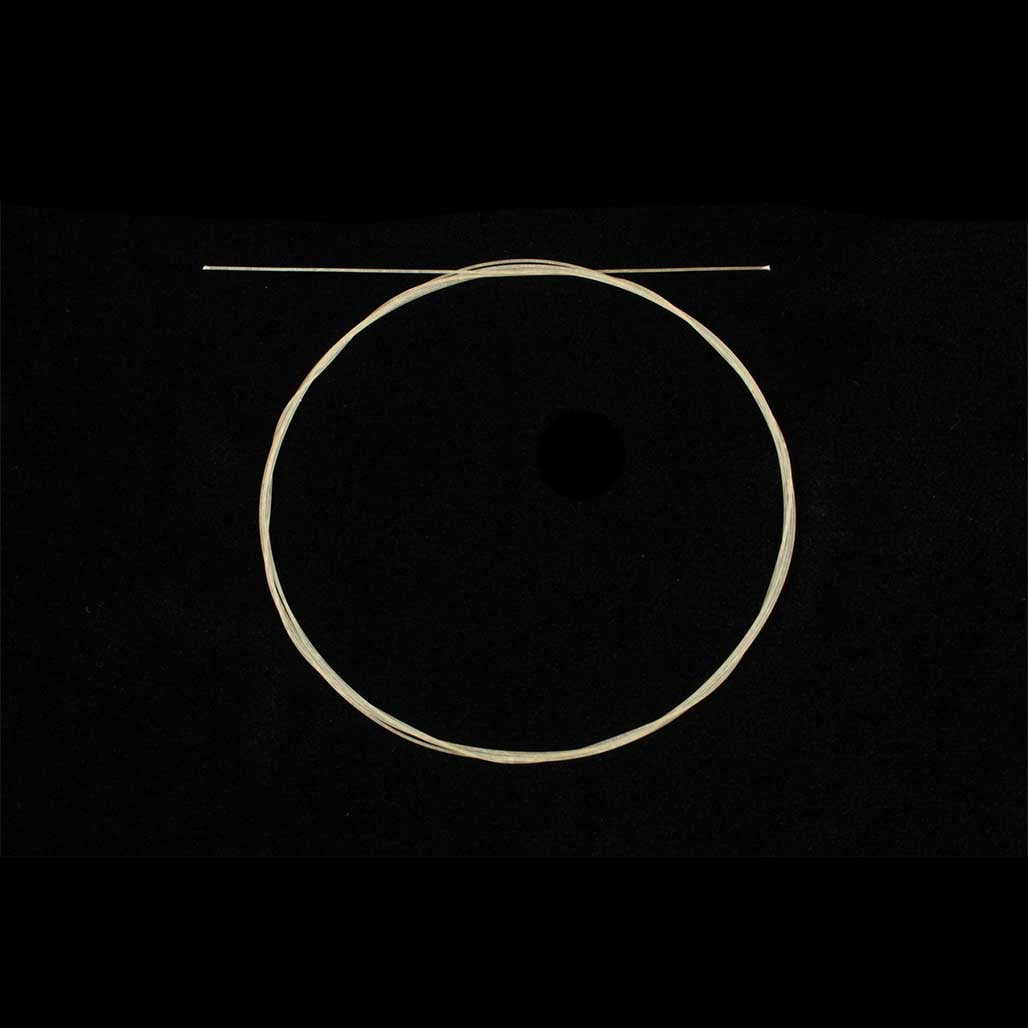

Description
| ET Viola a-1 Gut Gauges | |
| Light | 0.72mm |
| Light+ | 0.74mm |
| Medium | 0.76mm |
| Medium+ | 0.78mm |
| Heavy | 0.80mm |
| Heavy+ | 0.82mm |
-
String Length: Double-Length, 64"/160cm
-
String Type: Treble Gut
-
String Material: Beef Gut
-
Tuning Designation: a=415
Treble Gut is processed to be a little harder than the other kinds of gut. The string also has a lower twist of about 15 degrees. This construction gives it the strength and resistance it needs to stand the strain in the treble register. The color ranges from clear white to opaque yellow.
Equal Tension strings are designed according to the recommendation of historical theoreticians such as Mersenne, who felt that for the instrument to be balanced and respond in proportion, all the strings on the instrument should have the same tension.
The string comes with plain, unknotted ends. 3-D Printed Ball Ends may be added for an additional charge. Instructions on how to tie a string knot are on the back of each package.
Plain gut strings are available with a natural or varnish finish. Natural strings are hand-rubbed with a light oil. Varnished strings have three coats of finish before being hand-polished with the oil.

Tuning Considerations
Gamut Academie Gut Viola Strings are designed for Baroque instruments by those musicians playing historical performance practice at a=415, and are perfectly suitable for modern a=440 practice, but the result will be a little bit more tension at a=440.
Technical Considerations
Beef gut (beef serosa) has a higher tensile strength than does sheep gut, so this string is useful for instruments that require extra durability. If your instrument has a longer string length which puts it beyond the comfortable range for sheep gut strings, the beef gut would be a good choice for string selection as it will stand the strain a little better.
Because of the added diameter of equal tension strings, your instrument may need some adjustment at the tailpiece, bridge, or nut to allow for the extra mass of the strings. The instrument may also need sound post or other adjustments to bring out the most responsive tone.
These are our standard recommended gauges for this instrument/string. For gauges outside of this range, see our Custom Gauged Strings section.
All Gamut string set prices are based off of the individual string prices; there is no penalty for ordering strings à la carte.
Historical Considerations
Equal Tension is a concept that was used on violins historically, and the idea is that each string on the instrument has an equal amount of tension. The customary way to tension strings is to decrease the tension from the top string, which has the most tension, to the bottom string in decreasing amounts on each string. From the 16th to 19th centuries there are writers who mention or recommend equal tension, and this seems to have been one aesthetic that some players used. Regardless of the extent of the historical use, many modern players find that this system of string allows a quicker and louder response from the instrument. The extra tension on the lower strings allows the bow to play more on top of the strings resulting in quicker bowing.
Further Reading
Viola (Baroque, Classical)
What is Equal Tension?
Early Music / Historically Informed Performance
Historical String-Making
Care and Cleaning of Gut Strings
String Calculator
|